

CoolCove Issues 2026 Seasonal Indoor Comfort Awareness Update as U.S. Heat Advisories Increase Household Temperature Preparedness Concerns
CoolCove update focuses on indoor comfort planning, responsible appliance use, seasonal heat awareness, and household temperature safety considerations
Commerce, Calif.,, July 01, 2026 (GLOBE NEWSWIRE) -- CoolCove is associated with household consumer electronics products intended for personal indoor use. CoolCove products are not medical devices and are not intended to diagnose, treat, cure, or prevent any disease or condition.
CoolCove today issued a seasonal indoor comfort awareness update as elevated summer temperatures continue to affect households across parts of the United States. The National Weather Service has issued extreme heat warnings and advisories across much of the central and eastern United States this week, with heat indices forecast to reach 100 to 110 degrees Fahrenheit in some regions through the July Fourth holiday. Against that backdrop, CoolCove is emphasizing household temperature preparedness, responsible appliance use, and general indoor comfort planning as consumers review how to manage living spaces during periods of elevated heat. Additional information is available on the official CoolCove website.
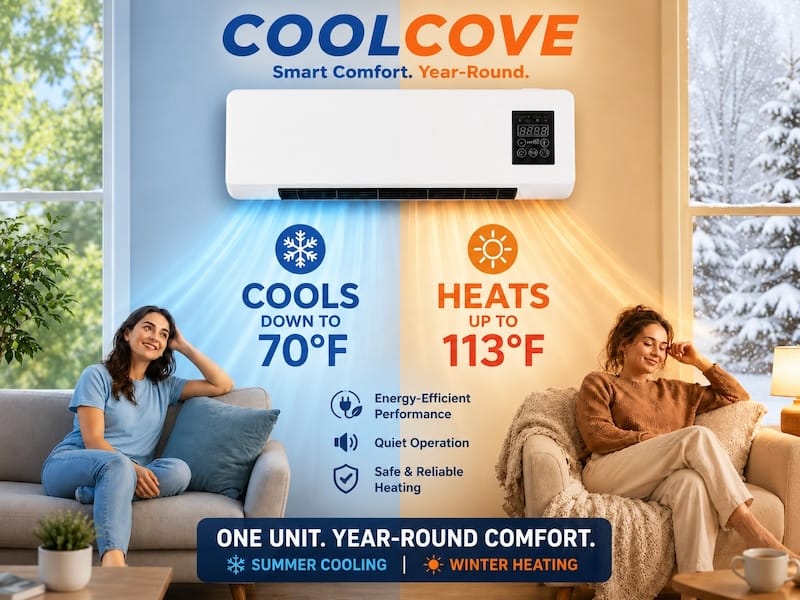
Seasonal Indoor Comfort Awareness
CoolCove's seasonal awareness update focuses on how households prepare indoor spaces during periods of extreme heat, high humidity, and colder seasonal temperature swings. Indoor comfort planning may involve central HVAC systems, room-based appliances, ceiling fans, insulation improvements, window coverings, ventilation habits, hydration planning, and access to public cooling resources when home cooling is limited.
CoolCove's 2026 communication effort emphasizes practical temperature preparedness rather than emergency response. Households are encouraged to think about which rooms are used most often, where vulnerable family members spend time, how airflow moves through the home, and whether electrical appliances are being used according to their included safety instructions.
Room-Based Climate-Control Category Context
Room-based climate-control products are part of a broader household comfort category that includes fans, portable appliances, dehumidifiers, window units, insulation improvements, curtains, and central HVAC systems. Consumers often evaluate these categories differently depending on room size, building age, access to windows, rental restrictions, utility costs, and the number of rooms occupied during the day.
Unlike whole-home HVAC planning, room-based comfort planning usually focuses on the spaces where people spend the most time, such as bedrooms, home offices, living rooms, or dorm-style spaces. This category-level distinction is important because households may prioritize different comfort strategies depending on whether they need broad whole-home temperature management or targeted support for specific rooms.
General Refrigerant Awareness in Cooling Categories
Cooling technologies vary by category. Compressor-based air conditioners commonly rely on refrigerant systems, while other household cooling categories may use airflow, evaporation, ventilation, or fan-assisted comfort mechanisms. Public discussion around cooling categories often includes terms such as refrigerant, compressor, evaporative cooling, airflow, venting, and BTU capacity, each of which refers to a different technical or performance consideration.
The U.S. Environmental Protection Agency regulates hydrofluorocarbon refrigerants used in most compressor-based cooling equipment under the American Innovation and Manufacturing Act, which set a phasedown schedule for high-global-warming-potential refrigerants beginning in 2022. Servicing activities that add or remove regulated refrigerant from compressor-based equipment require EPA-certified technicians under Section 608 of the Clean Air Act. Technical, installation, or servicing questions involving cooling appliances should be handled according to manufacturer instructions and, where appropriate, by qualified professionals for electrical work, refrigerant handling, permanent installation, or building modification.
Household Layout and Placement Considerations
Indoor comfort planning can vary significantly by household layout. Apartments, dormitory-style rooms, older homes, home offices, and smaller living spaces may present different considerations around outlet access, airflow, window availability, surface stability, cord placement, and furniture positioning. Households may also need to account for children, pets, shared walls, lease restrictions, and available floor space when using any household electrical appliance.
Placement is especially important for appliances that move air or generate heat. Vents should remain unobstructed, cords should be positioned to reduce trip hazards, and appliances should be used only in the manner described in their included instructions. Stable placement, adequate clearance, and regular inspection for visible damage are general safety considerations across many household electronics categories.
Apartment and Rental Housing Considerations
Renters may face different indoor comfort planning challenges than homeowners. Lease restrictions, limited window access, shared electrical circuits, small floor plans, and rules around permanent modifications can affect which comfort strategies are practical. Renters should review lease terms and building rules before installing, mounting, or modifying any household appliance or fixture.
In smaller apartments, airflow can be affected by furniture placement, closed doors, window direction, sunlight exposure, and room shape. Households may improve comfort planning by identifying the rooms that receive the most afternoon sun, keeping vents unobstructed, using window coverings during peak heat, and checking whether existing HVAC vents or fans are operating as intended.
Home Office and Dorm-Style Space Considerations
Home offices and dorm-style rooms often concentrate activity in one space for long periods of time. Computers, monitors, lighting, and other electronics can add heat to a room, while limited square footage may restrict where appliances can be placed safely. Temperature planning in these spaces often requires attention to airflow, outlet access, cord routing, and clear space around vents or fans.
For remote workers and students, indoor comfort can also affect focus and daily routines. General planning steps may include reducing direct sunlight during peak heat, keeping water nearby, avoiding unnecessary heat-generating appliances, and taking breaks from rooms that become uncomfortable during the warmest parts of the day.
Responsible Household Appliance Use
Consumers using household electrical appliances should read and follow all included instructions before operation. General safety practices include using appliances on stable surfaces, avoiding blocked vents, maintaining proper clearance, keeping cords away from high-traffic areas, avoiding contact with damaged plugs or cords, and discontinuing use if unusual operation, visible damage, odor, smoke, overheating, or electrical issues are observed.
Households with children, older adults, pets, or people with mobility limitations should pay particular attention to appliance placement and supervision. Electrical appliances should not be used in ways that conflict with their instructions, and consumers should avoid modifying cords, housings, mounts, plugs, vents, or protective components.
General Heat Safety Context
Extreme heat can place additional strain on households, particularly when nighttime temperatures remain elevated and indoor spaces do not cool down after sunset. Public health guidance commonly emphasizes hydration, reduced outdoor exertion, access to cooler indoor environments, and attention to symptoms associated with heat-related illness. The Centers for Disease Control and Prevention distinguishes between heat exhaustion, with symptoms including heavy sweating, cold or clammy skin, dizziness, and nausea, and the more serious heat stroke, marked by a body temperature above 103°F, hot and dry or damp skin, a rapid pulse, and confusion; heat stroke is a medical emergency requiring immediate attention.
Older adults, young children, outdoor workers, people without reliable cooling access, and individuals with certain cardiovascular or respiratory conditions may require additional planning during heat advisories. Any person experiencing severe heat-related symptoms should seek medical attention rather than relying on a household appliance or indoor comfort strategy alone.
Responsible Consumer Electronics Communication
CoolCove's seasonal update reflects a broader responsibility in consumer electronics communication: household products should be discussed with clear use boundaries, safety context, and appropriate disclaimers. Consumer electronics are not medical devices unless specifically classified as such, and household comfort products should not be presented as a substitute for medical advice, emergency services, public cooling resources, or professional HVAC guidance.
The company's communication approach for 2026 emphasizes category education, responsible appliance use, and household preparedness language. This approach is intended to help consumers understand general indoor comfort considerations without overstating product capabilities or replacing professional guidance where health, electrical, installation, or building-code issues are involved.
About CoolCove
CoolCove is associated with household consumer electronics products intended for personal indoor use. Onninest serves as the distributor of record for CoolCove-related customer service and media contact purposes. Additional information is available on the official CoolCove website.
Media Contact
Email: cs@onninest.com
Phone: 1-888-814-2188, Monday through Friday, 9:00 a.m. to 5:00 p.m.
Address: Onninest, 6413 Bandini Blvd, Commerce, CA 90040, USA
CoolCove consumer electronics products are intended for household use only. They are not medical devices and are not intended to diagnose, treat, cure, or prevent any disease or condition. Consumers managing health conditions affected by indoor temperature should consult a qualified healthcare professional for guidance.
This content includes a link to the official CoolCove website. Compensation may be earned from qualifying purchases made through that link, at no additional cost to the consumer.

Product Email Support: cs@onninest.com
Customer Service Phone: 1-888-814-2188, Monday through Friday, 9:00 a.m. to 5:00 p.m.

Legal Disclaimer:
EIN Presswire provides this news content "as is" without warranty of any kind. We do not accept any responsibility or liability for the accuracy, content, images, videos, licenses, completeness, legality, or reliability of the information contained in this article. If you have any complaints or copyright issues related to this article, kindly contact the author above.
